Building Vocabulary Through Conversation With Your Child
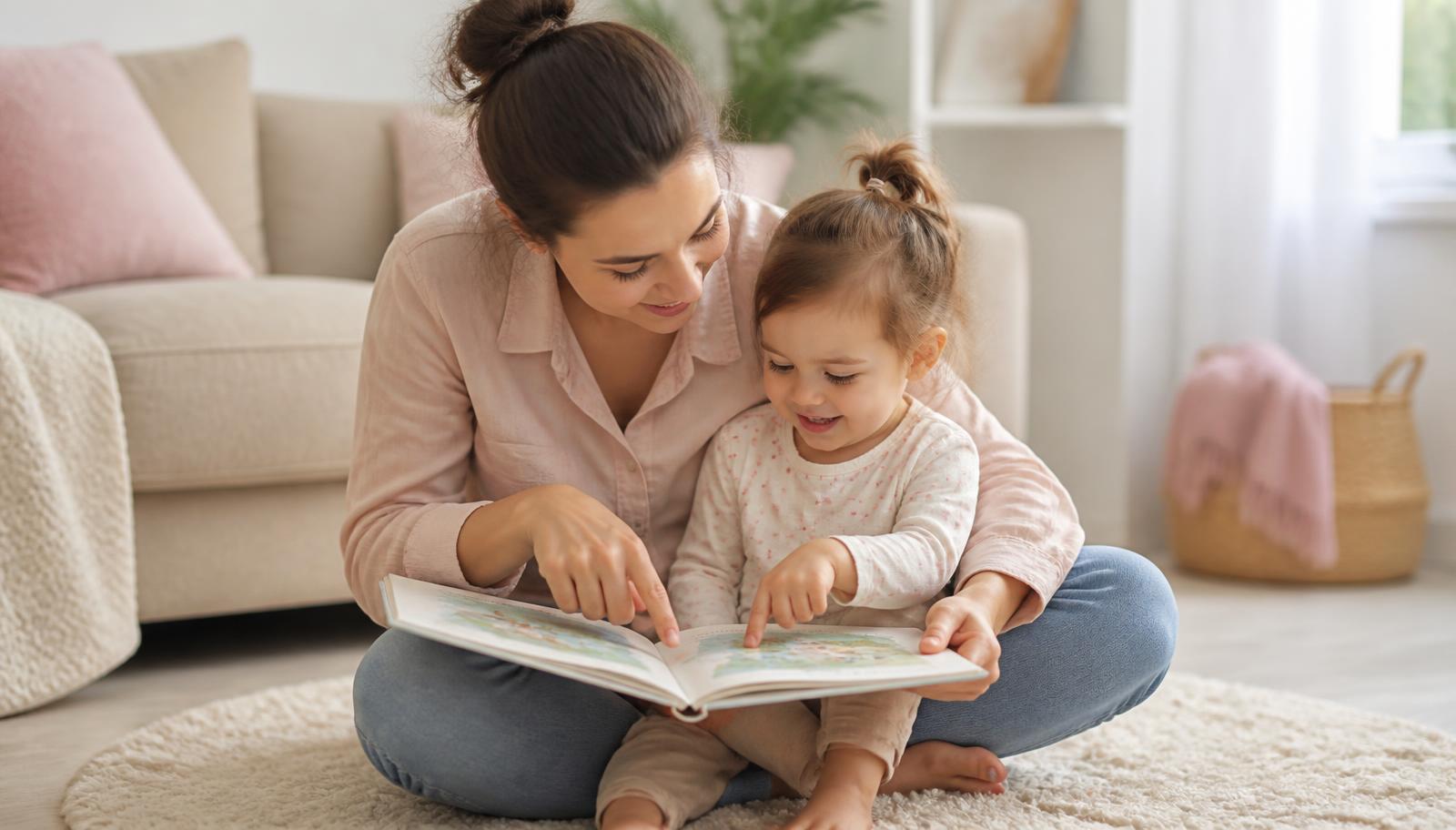
Build your toddler’s vocabulary through warm, responsive conversation during play, routines and shared reading—without pressure or quizzes.
You can build your child’s vocabulary by talking with them during ordinary moments, following their interests and giving them time to respond. Notice what they are looking at or doing, name it, and add a little more: if your toddler says “dog,” you might reply, “Yes, a fluffy dog is running.” This warm back-and-forth helps words feel meaningful.
You do not need special lessons, constant narration or flashcards. Short, responsive conversations during meals, dressing, play, walks and bath time are valuable. Use clear language, repeat useful words naturally, and welcome gestures, sounds and partial words as genuine attempts to communicate.
Start with connection, not correction
Children learn language best when conversation feels shared and enjoyable. Get close to your child’s level when possible, notice what has captured their attention and respond to it. A toddler examining a leaf is more likely to connect with words such as “crunchy,” “brown” and “stem” than with words about something they are not currently noticing.
Accept your child’s message before refining the language. If they say “tar” for “car,” answer the meaning rather than asking them to repeat it correctly: “Yes, a blue car. It is going fast.” Hearing the correct word in your reply provides a gentle model without turning conversation into a test.
Use the notice, name and add approach
A simple three-step pattern can make everyday talk richer:
- Notice: Follow your child’s gaze, gesture, sound or activity.
- Name: Put a clear word or short phrase to what they notice: “A truck!”
- Add: Expand the idea slightly: “The noisy truck is tipping sand.”
A useful guide is to respond with a phrase just a little longer or more detailed than your child’s. A child who communicates with gestures or single words may benefit from short phrases. A child already using sentences can hear extra describing, action, position and feeling words.
Create back-and-forth conversation
Conversation is more than an adult supplying words. Treat your child’s pointing, facial expressions, movements, babble and words as turns. Make a comment, then pause. Young children often need several quiet seconds to process language and decide how to respond.
Try not to fill every pause or ask a stream of questions. Comments such as “That tower is very tall” often invite more communication than “What colour is it? How many blocks? What is this?” When you do ask a question, choose one your child can answer with a gesture, sound or word, and give them time.
Talk during everyday routines
Repeated routines offer predictable opportunities to hear the same words in meaningful contexts. You could:
- At mealtimes: Talk about taste, texture, temperature and actions: “The banana is soft. You are peeling it.”
- While dressing: Name body parts, clothing and position words: “Your foot goes inside the sock.”
- During bath time: Use action words such as pour, splash, float, sink, squeeze and rinse.
- On walks: Notice sounds, movement, weather, vehicles, animals and signs.
- At bedtime: Recall one or two moments from the day: “We saw a tiny snail after the rain.”
Repetition is helpful, so do not worry about sounding repetitive. Children often need to hear a word many times and in different situations before they understand and use it.
Share books in a conversational way
Shared reading introduces words that may not arise in everyday routines. Let your child choose books, turn pages or linger over a favourite picture. You do not have to read every word. Follow their attention by naming, commenting and wondering together.
For example, you might say, “The bear looks worried. Maybe she cannot find her cub.” Connect the story to your child’s experiences: “We wore boots in puddles too.” Repeating favourite books supports anticipation and gives children another chance to join in with sounds, actions or familiar phrases.
For more ideas about play, routines and development, visit our toddler care hub. You can also explore play and learning for ways to make language part of child-led play.
Introduce a wide variety of words
Names for objects matter, but vocabulary also includes action, describing, location, quantity, emotion and thinking words. During play, add words such as wobble, enormous, beneath, empty, disappointed, remember and suppose when they fit naturally.
Explain an unfamiliar word briefly rather than replacing it with an easier one. You might say, “The path is narrow—it does not have much space across.” Use the word again later so your child hears it in another sentence. Keep your tone natural; an occasional interesting word is more manageable than a long list.
Use songs, pretend play and storytelling
Songs and rhymes make words memorable through rhythm, repetition and movement. Pause before a familiar word to let your child join in, while accepting any response. Pretend play also creates reasons to communicate: a toy animal can be hungry, a cardboard box can become a bus, or a doll may need comforting.
Tell simple stories about real experiences and invite your child to contribute. Looking at family photos can help: “We went to the beach. The wind blew your hat away!” Your child can point, act, make a sound or supply a word. These are all meaningful conversational turns.
Support more than one language
If your family uses more than one language, speak the language or languages in which you feel comfortable and connected. Rich, natural conversation with family members matters more than forcing one language. Songs, stories, books and conversations with relatives can help your child develop each language as part of family life.
It is normal for multilingual children to know some words in one language and others in another, or to use languages together. Avoid withholding a home language because you fear it will confuse your child. If there are concerns about communication, assessment should consider skills across all the child’s languages.
Keep screens in a supporting role
Children learn language most powerfully through interaction with responsive people. If you use age-appropriate media, watch together when possible and connect it with real life: name what you see, copy an action or talk about it later. Video calls can also be interactive when the other person pauses and responds to your child.
What to avoid
- Pressuring your child to “say it” before receiving what they need.
- Frequently correcting pronunciation or grammar.
- Testing with questions when you already know the answer.
- Comparing your child’s word count with another child’s.
- Expecting conversation when your child is overwhelmed, tired or hungry.
Communication develops at different rates. Focus on shared attention, understanding, gestures, sounds, words and enjoyment—not only on how many words your child says.
When to seek help
Contact your maternal health nurse, midwife, GP or a speech and language therapist if you are worried about your child’s communication, if they rarely respond to sounds or their name, do not seem to understand familiar language, use few gestures to communicate, or have persistent difficulty interacting with you. Arrange a hearing check if there is any concern about hearing, frequent ear infections or an apparent change in response to sound.
Seek prompt professional advice if your child loses words, gestures, social engagement or other abilities they previously used. Contact emergency services if the change is sudden or occurs with trouble breathing, severe weakness, a seizure, unusual unresponsiveness or another acute illness. You know your child best, and you do not need to wait for a milestone deadline before discussing a concern.