Baby Fever Guide — What's Normal, When to Worry, What Actually Helps
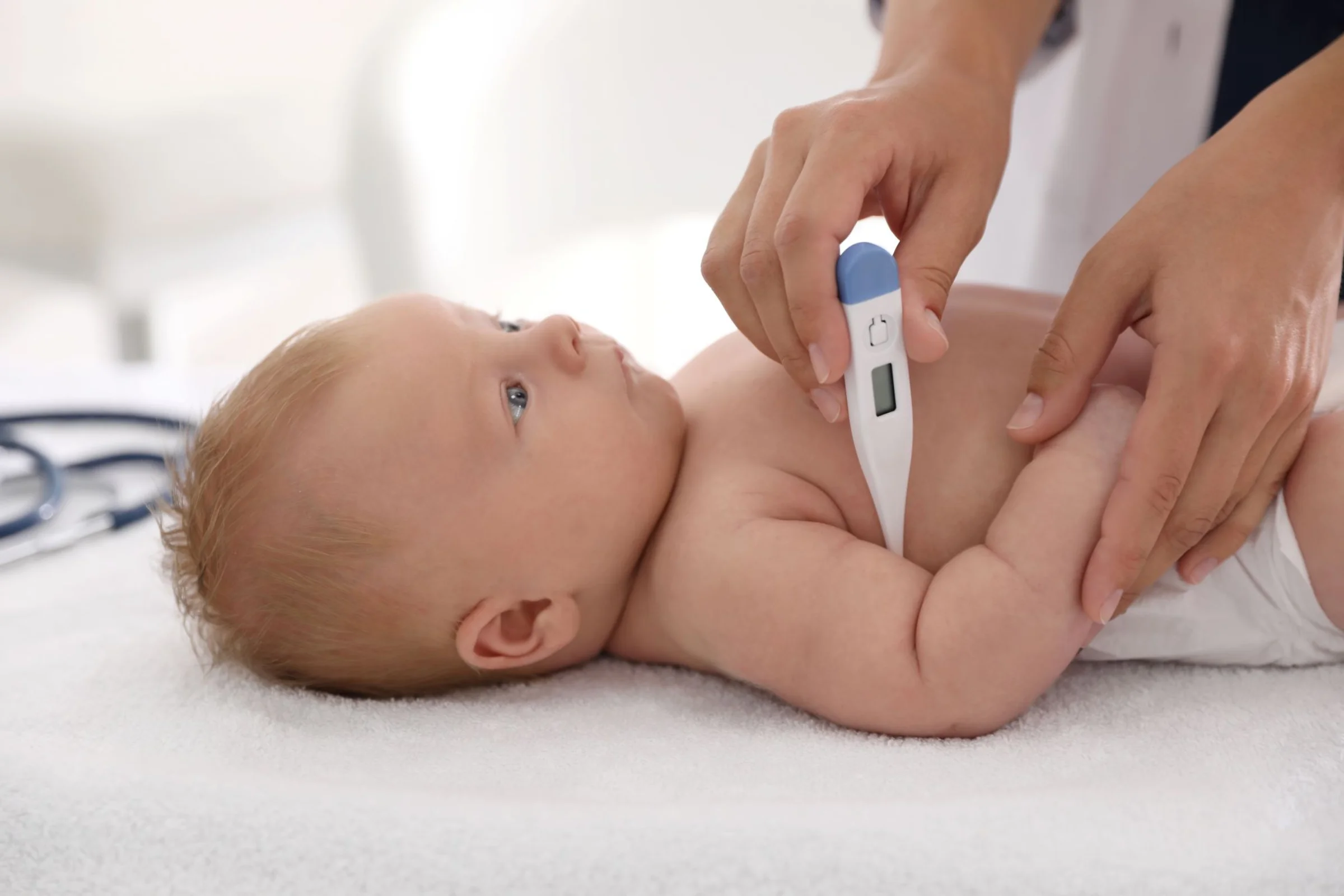
A Maternal Health Nurse's guide to baby fever: how to take a temperature accurately, what counts as a real fever, safe paracetamol and ibuprofen dosing, when it's urgent, and what actually helps your baby feel better.
Few things rattle a parent like a hot, floppy little body in your arms at 2am. The good news: in babies over 3 months, fever itself is rarely dangerous — it''s a sign the immune system is doing its job. What matters is how your baby is behaving, not the number on the thermometer.
This guide walks you through what counts as a real fever, how to measure temperature accurately, the red flags that mean call now, safe pain-relief dosing, and the comfort measures that genuinely help. Written from a Maternal Health Nurse lens, aligned with Red Nose, NHS and Royal Children''s Hospital Melbourne guidance.
What counts as a fever?
A normal body temperature for babies and children sits between 36.5°C and 37.5°C. A fever is generally defined as 38°C or higher when taken under the arm or in the ear. Forehead (temporal) thermometers can be a quick screen but are less reliable, especially in newborns.
- Low-grade fever: 38.0°C – 38.9°C
- Moderate fever: 39.0°C – 39.9°C
- High fever: 40°C or above
The height of the fever doesn''t reliably tell you how sick your baby is. A baby with 38.2°C who is floppy and hard to rouse needs urgent attention; a toddler with 39.8°C who is still drinking, weeing and playing in flashes is usually fighting a routine viral illness.
How to take your baby''s temperature accurately
Method matters more than most parents realise:
- Under-arm (axillary): the recommended method for babies under 3 months. Hold the thermometer snug against bare skin for the full reading time.
- Ear (tympanic): reliable from around 6 months. Gently pull the ear back and up to straighten the canal.
- Forehead (infrared): convenient but easily affected by sweat, room temperature and technique. Use as a screen, then confirm with under-arm if it reads high.
- Mercury / glass thermometers: avoid — they''re no longer recommended.
Re-check 20–30 minutes after a bath, breastfeed or being heavily wrapped — all can falsely elevate readings.
When fever is urgent — call now
Call your GP, 13 HEALTH (1737 in NZ) or 000 / 111 / 911 immediately if your baby has any of these:
- Under 3 months old with a temperature of 38°C or higher — always assessed urgently, no exceptions.
- 3–6 months old with a fever of 39°C or higher.
- Fever lasting more than 48 hours without an obvious cause.
- A non-blanching rash (doesn''t fade when you press a glass against it).
- Stiff neck, bulging fontanelle, severe headache or sensitivity to light.
- Difficulty breathing, grunting, or sucking in around the ribs.
- Floppy, hard to wake, or unusually drowsy.
- Persistent vomiting, refusing fluids, or fewer than half their usual wet nappies.
- Blue, grey or very pale lips or skin.
- A seizure (febrile convulsion).
Trust your gut. If something feels wrong, it''s always reasonable to seek help — clinicians would rather see a well baby than miss a sick one.
What actually helps your baby feel better
The goal isn''t to push the number down — it''s to keep your baby comfortable and well-hydrated while their immune system does the work.
- Offer extra fluids. For under-6-months, keep up regular breast or formula feeds (often smaller, more often). Over 6 months, add water and a little extra milk.
- Dress lightly. One light layer plus a thin sheet. Overwrapping traps heat and pushes the fever higher.
- Keep the room comfortable. Around 18–20°C with good airflow. Skip electric blankets and heaters pointed at the cot.
- Cool cloths, not cold baths. A lukewarm flannel to the forehead can soothe; a cold bath can cause shivering, which raises core temperature.
- Rest and contact. Skin-to-skin, a quiet room, and a familiar carrier or wrap often calm an unsettled fevered baby better than anything else.
Paracetamol and ibuprofen — safe dosing
Medication isn''t needed for the fever itself — only if your baby is uncomfortable, distressed, or struggling to feed or rest. Always dose by your baby''s weight, not their age, and use the syringe that comes with the bottle.
- Paracetamol (e.g. Panadol, Dymadon): from 1 month of age. 15 mg per kg per dose, every 4–6 hours, max 4 doses in 24 hours.
- Ibuprofen (e.g. Nurofen): only from 3 months and over 5 kg. 10 mg per kg per dose, every 6–8 hours, max 3 doses in 24 hours. Give with a feed to protect the stomach. Avoid if your baby is dehydrated, vomiting, has chickenpox or kidney issues.
- Never combine routinely. Alternating paracetamol and ibuprofen is sometimes advised by clinicians for short stretches — don''t do it on your own without guidance.
- Aspirin is never given to babies or children under 16 (Reye''s syndrome risk).
If you''re unsure of the dose, ring your pharmacist or 13 HEALTH — they''ll calculate it with you in under a minute.
Febrile convulsions — what to know
Febrile convulsions affect about 3 in 100 children between 6 months and 5 years. They are frightening to watch but, in the vast majority of cases, harmless and not a sign of epilepsy.
If your baby has a seizure:
- Lay them on their side on a soft surface, away from anything hard.
- Don''t put anything in their mouth.
- Time the seizure.
- Call 000 / 111 / 911 if it lasts longer than 5 minutes, if it''s their first seizure, or if they don''t recover quickly afterwards.
- Any baby who has had a febrile convulsion should be seen by a doctor that day, even if they seem well again.
The 4 questions to ask yourself at 2am
When you''re trying to decide whether to wait, ring, or drive in, run through these:
- How are they behaving between fever spikes? Smiling, drinking, making eye contact = reassuring. Floppy, unresponsive = urgent.
- Are they keeping fluids down? Wet nappies every 6–8 hours is the goal.
- Is their breathing normal? Fast, grunting or laboured breathing always warrants assessment.
- Does anything feel wrong that you can''t explain? That instinct is data. Act on it.
When the fever is gone — but they''re still not themselves
It''s normal for babies to be clingy, off their food, and sleeping oddly for a few days after a viral illness. Sleep often regresses for a week or two — this is recovery, not a new sleep problem to solve. Once they''re back to themselves, our baby sleep plan can help you re-anchor naps and bedtime gently.
FAQ
What temperature is a fever in a baby?
38°C or higher when taken under the arm or in the ear. Anything between 36.5°C and 37.5°C is normal. Forehead readings can be a quick screen but should be confirmed under the arm if elevated.
When should I worry about my baby''s fever?
Always seek urgent care if your baby is under 3 months with any fever, or if they have a non-blanching rash, are floppy, hard to wake, breathing fast or refusing fluids. The number on the thermometer matters less than how your baby looks and behaves.
Should I give paracetamol for every fever?
No. Medication is for comfort, not the fever itself. If your baby is feeding, resting and reasonably content, you don''t need to medicate. If they''re distressed or unable to settle, paracetamol (from 1 month) or ibuprofen (from 3 months and over 5 kg) dosed by weight can help.
Can I bath my baby to bring a fever down?
A lukewarm sponge or flannel is fine and can be soothing. Don''t use cold water or ice baths — they cause shivering, which raises the core temperature and makes your baby feel worse.
Is a febrile convulsion dangerous?
It''s terrifying to witness but usually harmless. Most last less than 5 minutes and don''t cause lasting harm or mean your child has epilepsy. Lay them on their side, don''t restrain them, time the seizure, and call 000 if it lasts more than 5 minutes or is their first.
How long does a viral fever last in babies?
Most viral fevers settle within 2–3 days. A fever that lasts more than 48 hours, returns after seeming to resolve, or is climbing rather than easing should be reviewed by a clinician.
This article is general information from a Maternal Health Nurse perspective and does not replace personal medical advice. If you''re ever unsure about your baby, contact your GP, 13 HEALTH, or emergency services.
Related reading: when baby fever needs a GP
Related reading: baby bruises and warning signs
Related reading: baby hives and warning signs
Related reading: green baby poo and warning signs
Related reading: changes in a baby's soft spot