Tummy Time for Babies: An Australian Parent's Guide
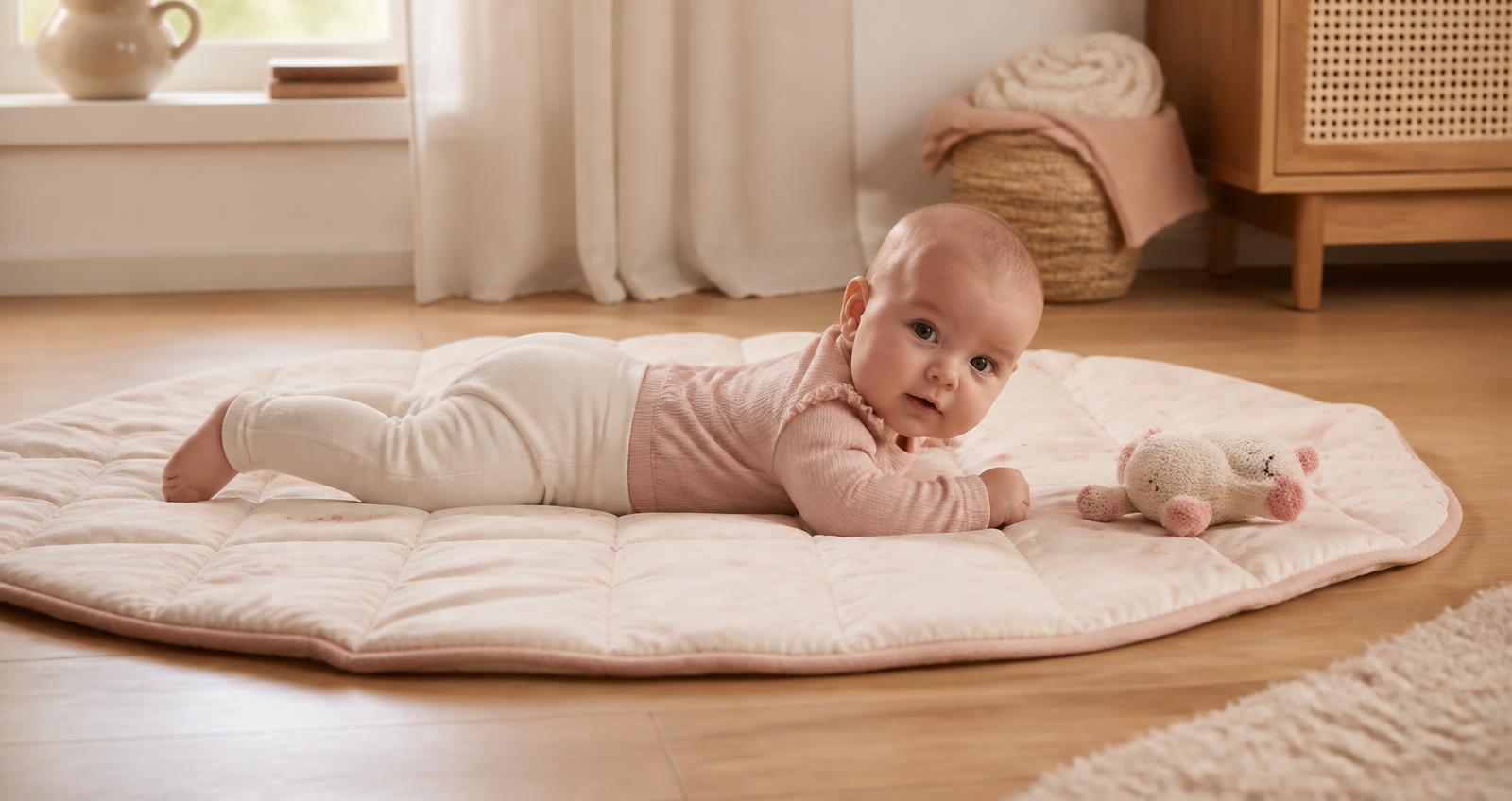
How much tummy time, when to start, and gentle ways to make those first minutes easier for both of you.
Tummy time is one of the simplest — and most evidence-based — things you can do for your baby's development. The Royal Children's Hospital Melbourne recommends starting from the first week home, even if it's only a minute at a time. Here's how Australian Maternal Health Nurses suggest building the habit without tears.

Why tummy time matters
Tummy time strengthens the neck, shoulders, arms and core. It supports motor milestones (rolling, sitting, crawling), prevents flat spots on the back of the head (plagiocephaly), and helps with vision and coordination. Babies who get regular tummy time tend to roll, sit and crawl earlier — though every baby is different.
When to start
You can start from day one. Lay your newborn chest-to-chest on you while you recline — that counts. By 2–3 weeks, add short floor sessions on a firm play mat. By 3 months, aim for a cumulative 30 minutes a day in shorter bursts (5–10 minutes at a time).

How much is enough?
- 0–4 weeks: a few minutes, several times a day — chest-to-chest counts.
- 1–3 months: 3–5 short sessions of 3–5 minutes.
- 3–6 months: aim for 30+ minutes total per day.
- 6 months+: usually self-selecting once baby rolls and crawls.
Make it easier (and tear-free)
Most resistance comes from frustration, not pain. Try these:
- Get down at eye level — your face is the best toy.
- Use a rolled muslin under the chest for extra support.
- Try after a nappy change, not right before a feed or sleep.
- Mirror, high-contrast book, or sibling at floor level all help.
If baby cries within seconds every time, log the pattern in the free Baby Tracker — sometimes reflux or wind is the real culprit.
Common worries
Tummy time can look harder than it is. A red face, grunting, or a few protests are normal. Stop if baby is exhausted, hungry, or distressed for more than a minute. Never leave a baby unsupervised on their tummy, and always put them on their back to sleep — Red Nose Australia safe-sleep guidance still applies.
Keep reading
- When do babies roll over?
- Language milestones 3–12 months
- Feeding & growth stages
- All free parenting tools
- Personalised care plans by a Maternal Health Nurse
Frequently asked questions
How long should newborns do tummy time?
Start with 1–3 minutes at a time, several times a day. Chest-to-chest cuddles count. By 3 months, aim for 30 minutes a day in short bursts.
What if my baby hates tummy time?
Most babies dislike it at first. Get down at eye level, keep sessions short, and try after a nappy change. Persistence beats duration.
Can tummy time cause reflux?
Tummy time pressing on a full stomach can trigger reflux. Wait 20–30 minutes after a feed.
Is rolling early bad?
No. Early rollers (3–4 months) are usually showing strong tummy-time gains. Stop swaddling once rolling begins.
When should I worry?
Speak to your Maternal & Child Health Nurse if your baby strongly favours one side, can't lift their head by 3 months, or has a noticeable flat spot.
This article is general information and not medical advice. For personalised support, speak to your GP or call Pregnancy, Birth and Baby on 1800 882 436.
A simple week-by-week tummy time plan
If you'd rather follow a structure than freestyle it, here's a 12-week roadmap Australian Maternal Health Nurses regularly share at new-parent groups. Adjust to your baby's mood — these are guidelines, not rules.
Weeks 1–2: chest-to-chest only
Lay your newborn skin-to-skin on your reclined chest after a nappy change. Aim for 2–3 sessions of just 1–2 minutes. Your heartbeat and voice do the regulation work. This counts as tummy time and is the easiest entry point.
Weeks 3–6: introduce the floor
Use a firm play mat in a draught-free spot. Place a rolled muslin under baby's chest so their arms come forward — this small trick removes most of the early frustration. Sessions of 3 minutes, 3–5 times a day.
Weeks 7–12: build endurance
Most babies start lifting their head 30–45° here. Introduce a soft baby mirror or high-contrast black-and-white book at eye level. Sessions of 5 minutes, working towards 30 minutes total per day by 3 months.
Months 4–6: the strength explosion
Expect the airplane pose (arms and legs lifted), rolling attempts, and reaching from tummy. Encourage with toys placed just out of reach to each side — this builds the asymmetric strength needed for rolling and crawling.
What Australian physiotherapists wish more parents knew
Paediatric physios who see referrals through the Child Development Service share a few recurring themes:
- Container baby syndrome is real. Hours spent in bouncers, swings, capsules and rockers reduce the floor time babies need to build core strength. Try to keep "container time" under 90 minutes a day.
- Variety beats duration. Five 6-minute sessions across the day build more strength than one 30-minute marathon.
- Side-lying is the secret weapon. Lay baby on their side with a rolled towel along their back — it's an easier on-ramp for babies who hate full tummy time and builds the same trunk muscles.
- Always supervised, always awake. Tummy time is play time, not sleep time. Back to sleep, tummy to play — every time.
Tummy time during an Australian summer
Heat changes everything. Babies overheat fast, especially during the 35°+ stretches we see across most of Australia from December to March.
- Use the coolest part of your house in the early morning or evening.
- Nappy and singlet only is fine — overdressing is the most common heat issue.
- Skip tummy time in the middle of the day; nap-and-cuddle through the heat instead.
- If using air conditioning, point vents away from baby and aim for room temp 22–24°C.
What other Australian parents have told us
From our community of over 40,000 Australian parents, three themes come up over and over in the tummy time conversation.
"I felt guilty I wasn't doing enough"
The number one feeling new parents share is guilt that tummy time isn't happening enough. The truth: every chest-to-chest cuddle counts, every nappy change ends with a moment on the mat counts, every carrier ride in an upright position builds the same trunk muscles. Stop counting minutes; build it into the daily rhythm.
"My baby screamed so I stopped"
If your baby cries within seconds every single time, the problem is rarely the tummy time itself. Check for: reflux (try 30 minutes after feeds), tiredness (try after a nap), positioning (rolled towel under chest), or temperature (cool floors). Adjust one variable at a time.
"I had no idea it mattered this much"
Daily floor play in the first six months sets the foundation for nearly every gross motor milestone in the first year. Babies who get consistent floor time generally roll, sit and crawl earlier — not because of pressure but because their bodies have had the chance to practise.
Tummy time quick-reference card
- Best time: 20–30 minutes after a feed, not before sleep.
- Best surface: firm play mat on a hard floor, not a soft bed.
- Best company: you, face-to-face, at eye level.
- Best entertainment: a baby mirror, a high-contrast book, a singing parent.
- Best response to a meltdown: pick baby up, cuddle, try again in 10 minutes.
- Best app: our free Baby Tracker logs sessions and shows your weekly total at a glance.
Bringing it all together
Tummy time is one of the smallest daily habits with one of the biggest long-term payoffs. Start tiny, stay consistent, follow your baby's cues, and trust the process. By 6 months you'll be looking at a stronger, more capable little person and quietly proud of those minutes you stitched together day after day.
Trusted Australian sources for further reading
- Raising Children Network — Australia's government-funded parenting site, packed with evidence-based articles and short videos.
- Royal Children's Hospital Melbourne — Kids Health Info — clinician-written fact sheets covering common newborn and toddler concerns.
- Australian Breastfeeding Association (ABA) — free helpline on 1800 686 268, seven days a week, staffed by trained breastfeeding counsellors.
- Pregnancy, Birth and Baby — free telehealth advice on 1800 882 436.
- healthdirect 13HEALTH — registered nurse advice 24/7 (1800 022 222 in most states).
- Tresillian & Karitane — free or low-cost sleep, settling and parenting support across NSW, ACT and increasingly nationwide.
- Red Nose Australia — current safe-sleep guidance for every age and stage.
A note from our Maternal Health Nurse team
This article was reviewed by a registered Australian Maternal & Child Health Nurse on our editorial team. Our goal is to give you calm, accurate, evidence-based information that respects your instincts and your family's individual circumstances. We do not replace your own GP, MCH nurse, paediatrician or other treating clinician — but we hope we make the in-between moments easier.
If you'd like personalised guidance, our care plans are written by a registered Maternal Health Nurse and delivered to your inbox within 24 hours. They cover sleep, feeding, settling, behaviour and developmental concerns. Free tools — including our Baby Tracker, Sleep Coach and Ask Genie AI Midwife — are always available with a free account.
Above all, trust yourself. You know your baby better than anyone in the world.
Related reading: practical tummy time techniques
Related reading: when and how to start tummy time